Where Did Hagar and Ishmael Live?
Wilderness, Water, and the Formation of a Frontier Household
When Genesis turns from Abraham’s household to Hagar and Ishmael, the story also changes landscapes.
Hagar and her son do not simply leave one family and appear somewhere else. They are pushed beyond the protection of Abraham’s household into a setting where water, movement, and knowledge of terrain become immediate conditions of survival.
That geographic transition deserves more attention than it usually receives.
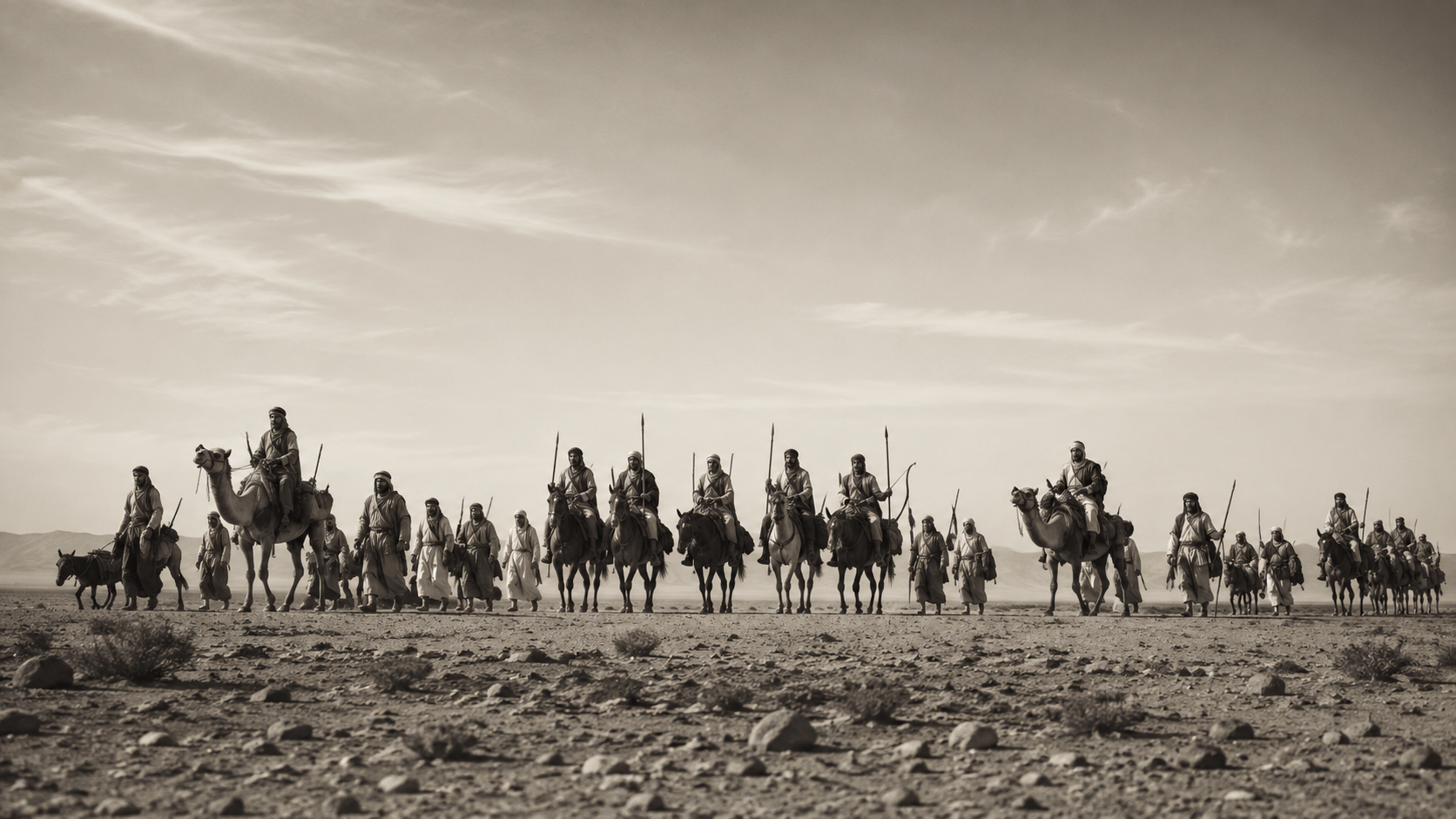
Genesis 21 places Hagar in the wilderness of Beersheba after her departure from Abraham’s household. The water she carries eventually runs out. Ishmael is placed beneath a shrub, and Hagar moves away because she cannot bear to watch him die. Only after water becomes available can the story continue.
The sequence is revealing:
household → wilderness → water crisis → well → survival → Paran → archery → new household
Read geographically, the episode is not merely about exile. It is about what happens when a household loses access to an established social and territorial network.
The Wilderness of Beersheba
“Wilderness” should not automatically be imagined as an absolutely empty desert.
The southern margins around Beersheba formed part of an environmentally demanding landscape in which rainfall was limited and access to dependable water could determine where people traveled, grazed animals, stopped, or settled.
That makes the water crisis in Genesis 21 more than scenery.
Abraham’s household possesses resources, livestock, servants, alliances, and negotiated relationships. Hagar leaves that network carrying only what Abraham gives her. Whatever protection membership in his household provided has disappeared.
The landscape now governs the story.
Once the water is exhausted, neither lineage nor inheritance can solve the immediate problem. Survival depends upon access to another source.
The well therefore occupies a structural position in the narrative. It restores the possibility of movement and life.
This is one of the recurring patterns that becomes visible when the patriarchal traditions are read through physical geography:
water is not decoration. It constrains what human beings can do.
From Beersheba to Paran
Genesis then gives Ishmael another geographic association:
He lives in the wilderness of Paran.
The exact boundaries and identification of biblical Paran remain debated, and the text should not be forced into a precision it does not provide. What matters first is the kind of landscape being described.
Ishmael is no longer living within Abraham’s household economy. His remembered environment is wilderness territory, and his life develops accordingly.
The text immediately adds another detail:
Ishmael becomes an archer.
That detail is easy to pass over as biography. Spatially, however, it is suggestive.
Archery is compatible with hunting, defense, and mobile life. At minimum, the narrative associates Ishmael’s maturity not with fields, permanent architecture, or administrative office, but with a skill that can function in a mobile and environmentally demanding setting.
That distinction matters.
Ishmael is adapting to the landscape into which he has been displaced.
The Southern Frontier Was Not Empty
The wilderness should not be confused with political emptiness either.
The broader southern geography remembered in the patriarchal traditions eventually includes Edomite, Horite, Midianite, Ishmaelite, Canaanite, and other populations occupying or moving through overlapping territorial worlds.
These groups should not be collapsed into one population, nor should later traditions simply be projected backward onto Genesis 21.
But together they remind us of something important: the southern margins formed a politically and economically active frontier.
Water sources, grazing areas, movement corridors, kinship networks, and negotiated authority could matter there as much as permanent settlement.
That gives Ishmael’s emergence outside Abraham’s household a different significance.
He has not been sent into an empty space beyond history.
He has entered a different kind of territorial world.
From Expelled Household to Frontier Household
This changes the way the episode can be read politically. Expulsion from Abraham’s household is not the end of Ishmael’s social history.
Genesis later remembers Ishmael as the ancestor of a substantial lineage. Genesis 21 has already begun explaining how that separate trajectory becomes possible. Hagar and Ishmael survive outside Abraham’s immediate territorial and household structure, and Ishmael eventually forms another household through marriage.
His mother obtains a wife for him from Egypt.
The movement is therefore not simply:
belonging → exile
It is:
belonging → exclusion → environmental crisis → adaptation → household formation
Seen this way, Ishmael does not merely disappear from Abraham’s story.
He begins another one.
The wilderness functions as the space in which that transformation occurs.
The Road Toward Egypt Appears Again
That wider southern geography becomes important later in Genesis.
The Joseph narrative remembers Ishmaelite and Midianite traders moving through the southern landscape toward Egypt, carrying goods through a long-distance exchange network.
The terminology in the Joseph tradition raises its own historical and textual questions, and the labels should not be treated as if Genesis were providing a modern ethnographic map.
But the geographic continuity is striking.
A lineage first associated with wilderness survival and mobility later appears within a remembered world of caravan movement connecting the southern Levant and Egypt.
That does not mean Genesis 21 predicts the caravan of Genesis 37.
It does mean that Ishmael’s association with the southern frontier does not disappear from the larger geographic memory of Genesis.
Explore the related investigation: How Did Joseph’s Famine Administration Transform Egypt? →
Ishmael and Jacob: Two Territorial Trajectories
The contrast with Jacob is especially revealing.
Jacob also leaves an established household and later confronts the problem of territory. But his trajectory moves in the opposite direction.
Jacob returns.
His story eventually brings him toward the Yabboq, where he must cross into a landscape occupied by kin, claims, settlements, and competing authority. His problem is re-entry.
Ishmael’s problem is formation outside the household from which he has been expelled.
That produces two different territorial patterns:
Jacob: departure → accumulation → return → boundary crossing → confrontation → succession
Ishmael: exclusion → wilderness → water crisis → adaptation → marriage → new household
Jacob negotiates his return to a world of kinship claims. Ishmael develops beyond the territorial structure that excluded him. The distinction helps explain why geography matters to these narratives.
The land does not merely provide the background against which family stories occur.
Different landscapes create different political possibilities.
Environmental Pressure and the Movement of Households
The same principle appears repeatedly across the patriarchal narratives.
Environmental conditions place limits on where households can remain, how they move, and which political relationships become possible.
For Hagar and Ishmael, the immediate constraint is water.
Later traditions remember famine pushing households and exchange networks southward toward Egypt. Jacob’s family eventually enters Egypt under precisely that kind of environmental pressure, while Joseph’s position within Egyptian administration turns scarcity into a question of political authority.
These episodes should not be collapsed into a single environmental event.
But they share a larger geographic logic:
when the land changes what is possible, households move.
And when households move, kinship, political authority, trade, and territorial relationships move with them.
Ishmael’s wilderness adaptation therefore belongs to a larger pattern running through the patriarchal world rather than standing outside it.
A Frontier Formation
The cautious historical-geographic claim is not that Genesis allows us to locate Ishmael with archaeological precision.
It does not.
Nor does geography prove the historicity of an individual Ishmael.
What geography can do is test whether the social and environmental relationships remembered by the narrative make sense within the landscapes being described.
In Genesis 21, several relationships appear together:
water scarcity, wilderness mobility, loss of household protection, specialized survival skills, marriage outside the original household, and the emergence of a separate lineage.
Taken together, they preserve a recognizable logic of frontier formation.
Hagar and Ishmael are pushed beyond one household order.
They survive.
Then they create another.
That may be the more important geographic question hidden beneath the familiar story of the well:
not simply where Hagar and Ishmael went, but what kind of household could emerge once they got there.
Part of a Larger Investigation
Hagar and Ishmael’s movement into the southern wilderness belongs to a larger geographic pattern linking migration, water access, household formation, territorial margins, trade corridors, and remembered movement across the patriarchal narratives.
Explore the larger reconstruction: Where Is the Land of the Patriarchs? →