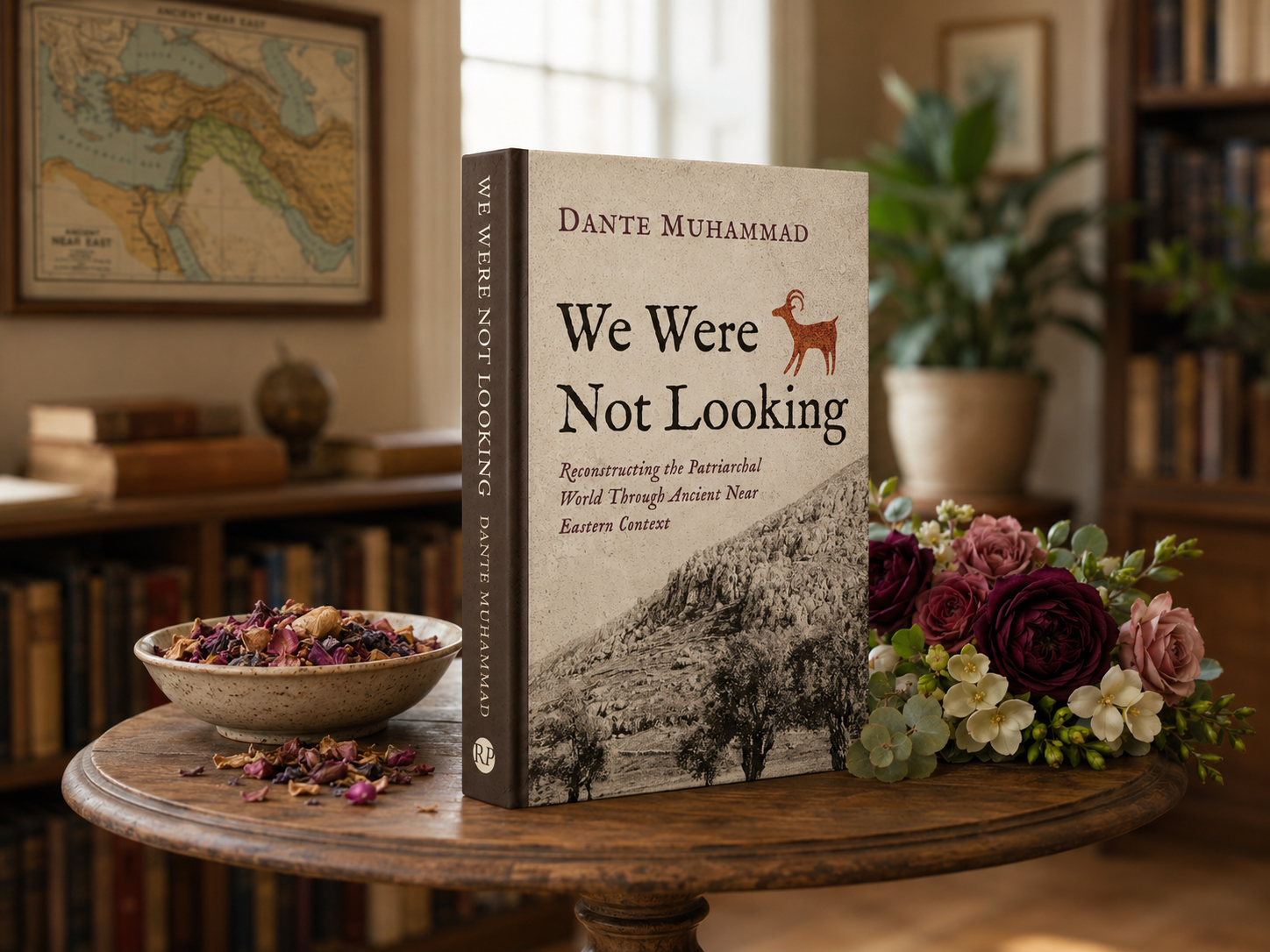
You think you know the story of Abraham.
You don’t know the world that made him.
A stranger from another culture who leaves his homeland and enters a world of tribal alliances, war, famine, contested territory, broken oaths, sacrifice, and survival.
Then he encounters El.
From that encounter comes a Covenant whose memory still runs through Judaism, Christianity, and Islam.
But what was that Covenant before centuries of tradition told us what it meant?
Follow Abraham back to the land.
THE MEETING THAT CHANGED EVERYTHING
Before Abraham became the patriarch claimed by later religions, he was a man moving through an ancient world.
He needed water.
He crossed other peoples’ territory.
He negotiated alliances.
He encountered kings.
He went to war.
He built altars.
He made oaths.
He faced famine, inheritance disputes, household conflict, sacrifice, and the constant vulnerability of tribal life.
And somewhere inside that world, Abram’s relationship with El becomes Covenant.
We Were Not Looking asks what happens when we stop beginning with later theology and return Abraham to the physical world in which that relationship unfolded.
The roads.
The wells.
The mountains.
The political boundaries.
The kinship networks.
The sacred places.
The land itself.
Because the prophets did not move through empty space.
WHAT DID ABRAHAM LEAVE BEHIND?
Not a theological system neatly packaged for later generations.
A trail.
Movements across territory.
Altars.
Wells.
Boundaries.
Oaths.
Kinship relationships.
Conflicts.
Places remembered long after the people themselves were gone.
Those clues survive within the Torah, the Qur’an, ancient geography, political memory, and the landscape.
And once they are placed back together, familiar stories begin to change.
Why does Abraham move where he does?
Why do particular mountains matter?
Why does access to water repeatedly become political?
Why is Covenant tied so closely to land and inheritance?
Why do Abraham’s descendants continue returning to the same geographic and covenantal questions?
If you think you already know this story, think again.
WAR. FAMINE. ESPIONAGE. OATHS. SACRIFICE. COVENANT.
The patriarchal world was not quiet.
Kings formed coalitions.
Territories changed hands.
Families negotiated survival.
Famine moved populations.
Messengers carried intelligence.
Oaths created obligations.
Kinship could protect you or place you in danger.
Land meant power.
Water meant life.
And Covenant unfolded inside all of it.
We Were Not Looking reconstructs that world through ancient Near Eastern history, historical geography, hydrology, political geography, land law, archaeology, and the parallel memories preserved in the Torah and Qur’an.
The method is rigorous.
The story is anything but dry.
TWO WITNESSES. ONE ANCIENT WORLD.
The Torah and Qur’an do not always remember Abraham and his descendants in the same way.
That is precisely why the comparison matters.
Instead of forcing the traditions into agreement, We Were Not Looking asks what becomes visible when each is allowed to testify independently and both are returned to the physical world they describe.
Land.
Water.
Migration.
Territory.
Kinship.
Political authority.
Sacred geography.
The result is a different way of approaching Abraham.
Before asking which later community owns him, we ask:
What happened to him?
And before deciding what the Covenant means today:
What was the Covenant in the world where it began?
WHY READ IT?
Because Abraham is more than the figure later traditions inherited.
He was a migrant.
A tribal patriarch.
A negotiator.
A survivor.
A man moving through dangerous territory toward something neither he nor his descendants could yet fully see.
His story becomes Isaac’s.
Then Jacob’s.
Then Joseph’s.
Then the story of peoples, territories, sanctuaries, competing memories, and communities that still look back toward Abraham today.
We Were Not Looking follows that trail.
Not simply to ask who inherited the Covenant.
But what they inherited.
“This haunting book is a poetic meditation that evokes the soul of a land, specifically the geographic corridor from which emerged the foundational texts of Judaism, Christianity, and Islam. Like every good poem, it gives voice to the silent and grants access to overlooked aspects of memory and experience. In language both imaginative and strikingly concrete, Dante Muhammad portrays this land, not as an inert repository of stories and artifacts, but as a living creature, even the chief protagonist in the ages-long drama that birthed and nurtured both cultures and faiths. This study in political geography could open up fresh readings of Scriptures and likewise new avenues for interfaith conversations in our own age of acute strife within and between our traditions.”
—Ellen F. Davis, Amos Ragan Kearns Distinguished Professor of Bible and Practical Theology, Duke Divinity School
“We Were Not Looking is an eye‑opening work that brings the land itself to the center of the biblical story, challenging long-standing anthropocentric readings. Dante Muhammad offers a compelling retelling of the biblical tradition—poetic in voice yet firmly grounded in current scholarship. By drawing on the Qur’an and Islamic sources alongside the Hebrew Bible, he illuminates the shared landscapes and sacred geographies that shape both traditions. This book is a much-needed call to look again, and to look more deeply.”
—John Kaltner, Virginia Ballou McGehee Professor of Muslim-Christian Relations, Rhodes College
You’ve read the stories. Now see what you’ve been missing.