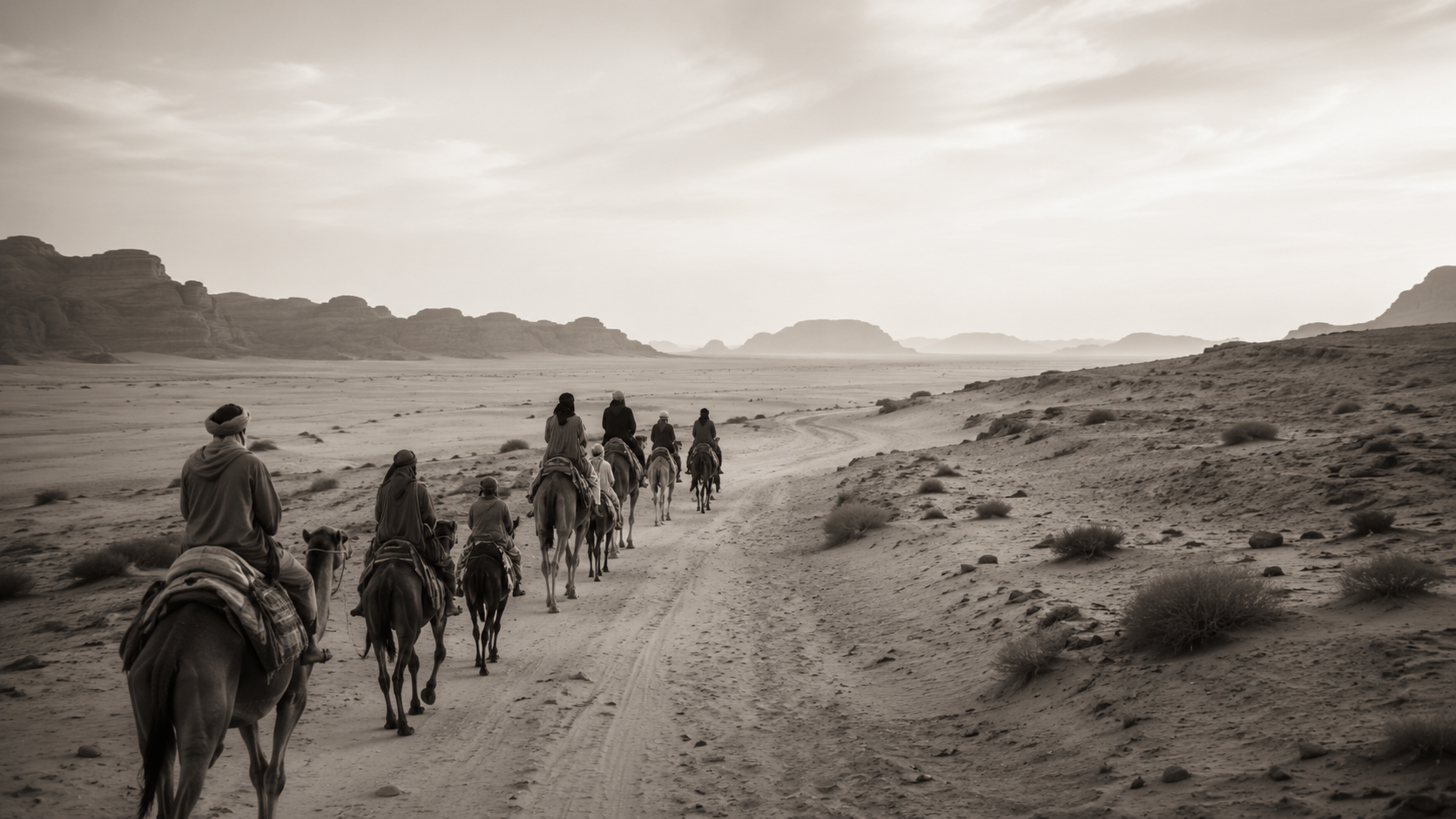
Was Muhammad Shown a Physical Path?
ٱهْدِنَا ٱلصِّرَاطَ ٱلْمُسْتَقِيمَ
“Guide us in the right path.”
Qur’an 1:6
The Isrāʾ and Miʿrāj traditions remember Muhammad being taken, shown, guided, and moved through sacred space. Read alongside the Qur’an’s recurring language of facing, turning, following, and orientation, they raise a historical-geographic question: could remembered guidance also preserve the memory of physical movement through landscape?
Muhammad’s Miʿrāj: Was the Night Journey a Physical Path?
Could remembered guidance also preserve the memory of a physical route?
The Night Journey and Miʿrāj are usually approached through theology: revelation, ascent, prophetic encounter, prayer, and the signs shown to Muhammad.
Those questions matter. But they are not the only questions the tradition allows us to ask.
The Qur’an repeatedly describes prophetic life through language of movement, direction, turning, following, paths, boundaries, and places. Abraham travels. Hajar and Ismail enter wilderness. Jacob crosses a river threshold. Moses moves through wells, mountains, settlements, and contested territory.
So what happens when Muhammad is placed back into that same physical world?
The question here is not whether geography can explain the Miʿrāj, nor whether terrain can prove a sacred event.
It is narrower:
Does the remembered guidance surrounding Muhammad preserve geographic relationships that become visible when read against the older prophetic landscape?
Muhammad Did Not Live in an Empty Arabia
The world surrounding Muhammad was connected by routes long before Islam.
Yathrib belonged to an economic and political landscape extending north through Khaybar and Tabūk toward Maʿān, Petra, Aila, and the southern Levant.
These were not arbitrary points on a map.
Water scarcity, wadis, mountain passes, settlements, caravan routes, and political frontiers concentrated movement into particular corridors. The Roman frontier itself followed much of this environmental logic. Roads and garrisons appeared where water, trade, taxation, and movement converged.
The Via Nova Traiana, running through the Transjordanian world toward Petra and Aila, formalized a route system whose logic was older than the pavement laid upon it.
Muhammad therefore emerged within a landscape already oriented northward by commerce, kinship, water access, imperial pressure, and inherited sacred memory.
That does not establish a route for the Miʿrāj.
It establishes something more basic:
the world remembered by the tradition was geographically connected.
The Miʿrāj as a Geographic Question
The Qur’an opens its account of the Night Journey with movement between sacred places:
“Glory be to Him who took His servant by night from the Sacred Mosque to the Furthest Mosque…”
The verse does not give us a travel itinerary.
But it does give us departure, destination, direction, sacred space, and movement.
The Miʿrāj then extends that movement beyond ordinary geography. Muhammad is shown signs and brought to a boundary beyond normal human experience.
Yet the ascent does not erase the earth beneath it.
The remembered journey begins in sacred geography and returns Muhammad to a world in which direction itself becomes consequential.
This is why the Miʿrāj matters to the larger investigation.
The ascent to the furthest boundary can be read not as an abandonment of terrestrial geography, but as part of a sequence in which Muhammad is repositioned within the older Abrahamic landscape.
From Abraham to Muhammad
The Qur’an repeatedly places Muhammad in relationship to Ibrāhīm.
That relationship is usually described doctrinally: monotheism, submission, covenant, prophetic continuity.
But Abraham’s remembered life is also intensely geographic.
He leaves territory.
He follows routes.
He encounters wells.
He builds altars.
He negotiates land.
He crosses political boundaries.
He is associated with sacred places that remain attached to later communities.
When the Qur’an instructs Muhammad to follow the millah of Ibrāhīm, the language therefore enters a tradition in which Abraham’s “way” was never detached from movement through real land.
That observation does not require turning every theological term into a road on a map.
It does require asking whether we have made those terms too abstract.
Millah: An Inherited Way
The Qur’an repeatedly speaks of the millah of Ibrāhīm.
Millah can describe an inherited way, a transmitted communal pattern, a path of belonging.
Within this research, the term becomes especially important because Abraham’s inheritance is remembered not merely as a set of propositions, but through movement, covenant, land, altars, wells, descendants, and territorial stations.
His way is something that can be followed.
Something can therefore also be lost.
And something lost can be restored.
This is where the Qur’anic language begins to intersect with physical geography.
Ḥanīf: Reorientation Toward an Older Axis
The Qur’an describes Ibrāhīm as ḥanīf.
Rather than treating the word only as a later religious category, this investigation reads its directional force seriously: an inclination away from prevailing alignments and toward an earlier orientation.
That becomes significant when Muhammad appears in a world containing competing claims to Abraham.
Different communities possessed scripture, sanctuary, lineage, law, and memories of sacred history.
The Qur’an does not simply add another claim to that collection.
It repeatedly returns behind those claims to Abraham himself.
The question becomes one of alignment.
What happens if Muhammad’s prophetic task is understood not simply as establishing something new, but as realigning a fragmented sacred world with an older Abrahamic axis?
Ṣirāṭ: A Path That Can Be Followed
Few Qur’anic words are more familiar than ṣirāṭ.
It is normally understood in moral and theological terms, especially through the prayer:
Guide us to the straight path.
But ṣirāṭ is path-language.
It describes something followed.
A route has orientation.
It leads somewhere.
It can be departed from.
It can be obstructed.
It can be recovered.
The point is not to claim that every occurrence of ṣirāṭ names a literal road.
The point is that the Qur’an expresses guidance through a vocabulary drawn repeatedly from movement and orientation.
Once that vocabulary is placed beside Abraham’s remembered journeys, the question becomes difficult to dismiss:
Could spiritual guidance and geographic memory sometimes be operating together rather than as mutually exclusive categories?
Law, Method, and the Walking of the Path
Two additional Qur’anic terms sharpen the distinction: shirʿah and minhāj.
Shirʿah concerns an appointed law or legal way appropriate to a community.
Minhāj concerns the method or manner by which that way is lived.
This distinction matters because continuity does not require every prophetic community to possess an identical social or legal structure.
Israel can belong to its covenant.
Earlier communities can possess their own forms of law and authority.
Muhammad can stand in continuity with them without simply reproducing their institutions.
The path continues even where the historical form changes.
This allows the Qur’an to remember continuity without sameness.
Muhaymin: Correction Without Erasure
The Qur’an also describes itself as muhaymin in relation to earlier revelation.
Within this study, the term is approached as the language of an overseeing or protecting witness: something capable of confirming, supervising, and correcting.
That is important because the Qur’an does not present Muhammad as emerging into a religious vacuum.
Earlier communities remain present.
Earlier revelation remains present.
Earlier sacred geography remains present.
But their memories have become contested.
The Qur’an enters that contested landscape not by pretending that nothing came before, but by repeatedly invoking what came before and asking where proper alignment now lies.
The Turning of Direction
This brings the investigation back to physical orientation.
The Qur’an remembers a moment when Muhammad and his community are commanded to turn.
A qiblah is theological, ritual, communal, and unmistakably geographic.
You face somewhere.
Direction produces a line across the earth.
The command therefore gives bodily form to the larger question running through the Qur’an: who stands in continuity with Abraham, and what does that continuity require?
The Miʿrāj, the Abrahamic inheritance, and the later turning of direction should not simply be collapsed into one event.
But within the narrative architecture, they belong to the same larger problem of guidance, orientation, sacred space, and inheritance.
Muhammad is shown.
Muhammad returns.
Muhammad is directed.
The community turns.
Guidance acquires orientation.
The First House and the Abrahamic Axis
The Qur’an eventually returns the argument to the First House, associated with Bakkah and with Ibrāhīm and Ismāʿīl raising its foundations.
Here the Qur’anic claim becomes striking.
Abrahamic continuity is not attached only to genealogy or doctrine.
It is attached to place.
The remembered act of Ibrāhīm and Ismāʿīl establishes a geographic anchor that later becomes the direction of Muhammad’s community.
The theological claim therefore has a physical expression:
a community turns its body toward a place remembered as Abrahamic.
Direction becomes inheritance enacted.
The Miʿrāj as a Geospatial Hinge
This is why the Miʿrāj occupies such an important place in the larger research.
It functions as a geospatial hinge between inherited sacred memory and restored orientation.
The Night Journey reaches beyond ordinary human movement, but it begins with sacred places.
The ascent reaches beyond terrestrial space, but Muhammad returns to terrestrial responsibility.
And the guidance that follows is expressed through paths, turning, facing, following, and alignment.
The Miʿrāj therefore does not have to be reduced to geography for geography to matter.
Quite the opposite.
The sacred event becomes more interesting when Muhammad is returned to the material world in which he actually lived: a world of caravan corridors, frontier settlements, water systems, inherited sanctuaries, competing communities, and remembered prophetic landscapes.
What This Argument Does Not Claim
This investigation does not claim that GIS can prove the Miʿrāj.
It does not claim that a caravan road can be identified as the route of the Night Journey.
It does not claim that theological vocabulary should always be read literally.
And it does not require the Torah and Qur’an to preserve identical geographic memories.
The proposal is more limited.
If earlier prophetic traditions preserve meaningful relationships among water, movement, settlement, territory, sanctuary, and authority, then the geographic vocabulary surrounding Muhammad deserves the same examination.
The purpose is not to resolve the sacred event.
It is to restore the physical world beneath the tradition and ask whether that world helps us see relationships that purely doctrinal readings can obscure.
The Larger Investigation
The Miʿrāj is therefore not an isolated curiosity within this project.
It belongs to the same investigation that asks:
Why does Abraham repeatedly appear at wells, altars, and territorial thresholds?
Why does Jacob’s return culminate at the Yabboq?
Why do wilderness stories turn repeatedly on water access?
Why do prophetic movements follow constrained corridors?
Why do sacred locations cluster around places where geography already made settlement, movement, and authority possible?
And why does the Qur’an so consistently describe restored guidance through the language of path, direction, turning, and return?
The larger hypothesis is not that geography replaces theology.
It is that the prophets did not move through empty space.
And neither did Muhammad.
Continue the Investigation
Read: When Guidance Starts to Look Like Geography
Explore the fuller argument about direction, movement, and the physical language of guidance.
→ Medium Article
Explore the Hydrological Spine Hypothesis
See the environmental model behind the project’s study of prophetic geography.
→ /hydrological-thresholds
Where Is the Land of the Patriarchs?
Follow the larger geographic system connecting the project’s individual investigations.
→ /land-of-the-patriarchs
Explore the Book
We Were Not Looking: Reconstructing the Patriarchal World Through Ancient Near Eastern Context
→ /we-were-not-looking