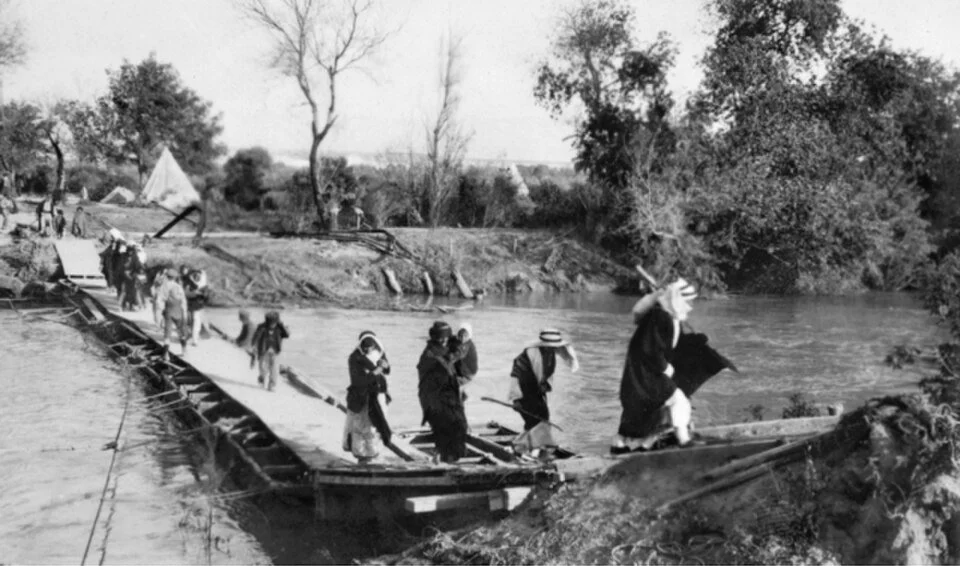
Where Did Jacob Cross the Jabbok?
Jacob’s return to Canaan culminates at the Yabboq — the modern Wadi Zarqa in Jordan; however the Torah does not preserve enough geographic detail to identify a specific ford with confidence.
The crossing is usually remembered because of the mysterious encounter in Genesis 32, but the geography raises another question:
Why does the narrative place Jacob at this particular river threshold before his encounter with Esau.
The Yabboq is not merely a dramatic backdrop. It is a deeply cut drainage corridor through Gilead, a place where movement is constrained by terrain and where crossing from one side of the watershed to the other carries real geographic consequences.
That makes the Yabboq unusually valuable for testing one of the larger claims developed in We Were Not Looking: that remembered movements in the patriarchal narratives can sometimes be examined against physical landscape structure rather than interpreted from the text alone.
What happens when the landscape is allowed to answer back?
Testing the Yabboq Without Starting With the Story
Rather than begin with Jacob’s remembered route and search for terrain that seemed to fit it, the workflow reverses the process.
Using NASA/USGS SRTM elevation data, drainage was derived from the terrain before independently mapped waterways were introduced.
The resulting networks were then compared against modern hydrography using both random‑cell and terrain‑matched controls across several spatial tolerances.
Across each tested tolerance, terrain‑derived drainage corresponded with independently mapped hydrography more strongly than either baseline. This does not identify Jacob’s crossing point. It establishes something narrower and more durable:
The Yabboq landscape contains a reproducible hydrological structure that can be detected independently of the narrative.
In other words, the terrain itself preserves a real corridor. Only after that structure is established independently can Jacob’s remembered movement be compared against its geographic logic.
Why does Jacob’s return culminate at this river? Explore the Yabboq as a geographic threshold.
So Where Did Jacob Cross?
Genesis places Jacob’s crossing somewhere along the Yabboq, the modern Wadi Zarqa in Jordan. The text does not preserve enough geographic detail to identify a particular ford with confidence.
What can be reconstructed is the physical setting:
Jacob’s return brought him to a constrained river corridor.
The Yabboq cuts across the landscape as a real physical obstacle that must be crossed.
The encounter with the mysterious figure happens at a genuine threshold.
The geography therefore matters even when the precise crossing point remains uncertain.
The story unfolds at an actual boundary — a place where movement, identity, and territory converge.
How does household conflict become territorial politics?
→ See the hidden political grammar behind Genesis 12–50.
Featured by BiblePlaces
Todd Bolen recently highlighted this reconstruction of the physical setting of Jacob’s Jabbok crossing on the BiblePlaces Blog.