A question keeps arriving in different forms and from different disciplines: What exactly is the method behind this research? A GIS practitioner asks about control sites. A biblical or Qur’anic scholar asks what geographical evidence can legitimately establish. A general reader asks the most basic question of all: Why does the landscape matter?
This essay answers those questions by mapping the research program as a whole. It explains how migration, kinship, water access, movement corridors, and political authority interact within the patriarchal narratives of the Torah and Qur’an. Its central claim is not that geography proves the narratives. It is that the narratives assume a material world whose terrain placed real constraints upon households, resources, movement, and territorial belonging.
Geography in these texts can be physical, political, literary, and symbolic at the same time. Treating it as material evidence does not replace theological or literary interpretation. It adds another layer of analysis and asks a disciplined question: What can the landscape clarify before we ask it to prove too much?
Migration and Sacred Geography in the Abraham Narratives
In the movement from Mesopotamia through Haran and into Canaan, the geographical details preserved in Genesis are not merely itinerary markers. They trace specific territorial boundaries and regional corridors that defined ancient political realities.
Read Next: Abraham & Canaan
Geography, Kinship, and Political Authority in the Patriarchal Narratives
The Prophets Did Not Move Through Empty Space
A research overview of migration, kinship, water access, movement corridors, and political authority in the patriarchal narratives of the Torah and Qur’an.

Kinship and Household Politics in Genesis
The internal mechanics of the patriarchal narratives turn on the strategic alignment of lineages. Kinship operates not merely as a domestic reality, but as a primary framework for political authority, treaty-making, and territorial preservation. Rather than viewing household alliances as purely cultural background, tracking these configurations reveals the legal and structural gravity behind tribal movements and succession.
Read Next: Kinship Politics and the Hidden Political Grammar of the Patriarchal Narratives
Wells, Famine, and Water Rights in the Patriarchal Narratives
Control over water in an arid environment is not merely an agricultural issue; it is the basis of political sovereignty. The narratives repeatedly emphasize disputes over wells, treaties negotiated at water sources, and famine-driven migrations. These are not incidental pastoral details. They reflect the hard hydrological realities that dictated where households could settle, who they had to ally with, and when they were forced to move.
Read Next: Hydrological Thresholds
Hydrological Thresholds and Ancient Movement Corridors
Physical geography dictates human movement. By mapping regional watersheds and elevation chokepoints, we can evaluate early narratives against environmental thresholds, testing whether the distribution of ancient settlements and travel routes corresponds to sustainable water corridors.
Read Next: GitHub GIS Workflow
Political Protection and Household Migration
Movement across ancient territories required administrative permission and political alignment. From the Egyptian frontier to Canaanite city-states, patriarchal households had to navigate complex jurisdictions, relying on shifting alliances and legal protections to secure safe passage and grazing rights.
Read Next: Related essays on Joseph/Yūsuf, migration, and political authority
Comparing the Torah and Qur’an
Both the Torah and the Qur'an preserve distinct, yet overlapping geographical memories. Placing these textual traditions in dialogue with landscape archaeology reveals shared spatial assumptions and highlights how different communities remembered and theologicalized the same rugged terrain.
Read Next: We Were Not Looking
Related public discussion: Hagar and Ishmael across Genesis, the Qur’an, and Islamic tradition
What Historical Geography Can and Cannot Establish
Geographical mapping does not "prove" theological claims, nor does it guarantee the biographical exactitude of ancient texts. It does, however, establish the material plausibility of the narratives, demonstrating that the authors operated within an accurate, grounded understanding of the region's physical and political constraints.
Explore the Research
The individual strands introduced here receive fuller treatment throughout the Research Hub, including migration and sacred geography, kinship politics, hydrological thresholds, administrative protection, and comparative readings of the Torah and Qur’an.
The open GIS repository documents the processing workflow and methodological assumptions so that the geographical claims can be examined independently from the larger interpretation.
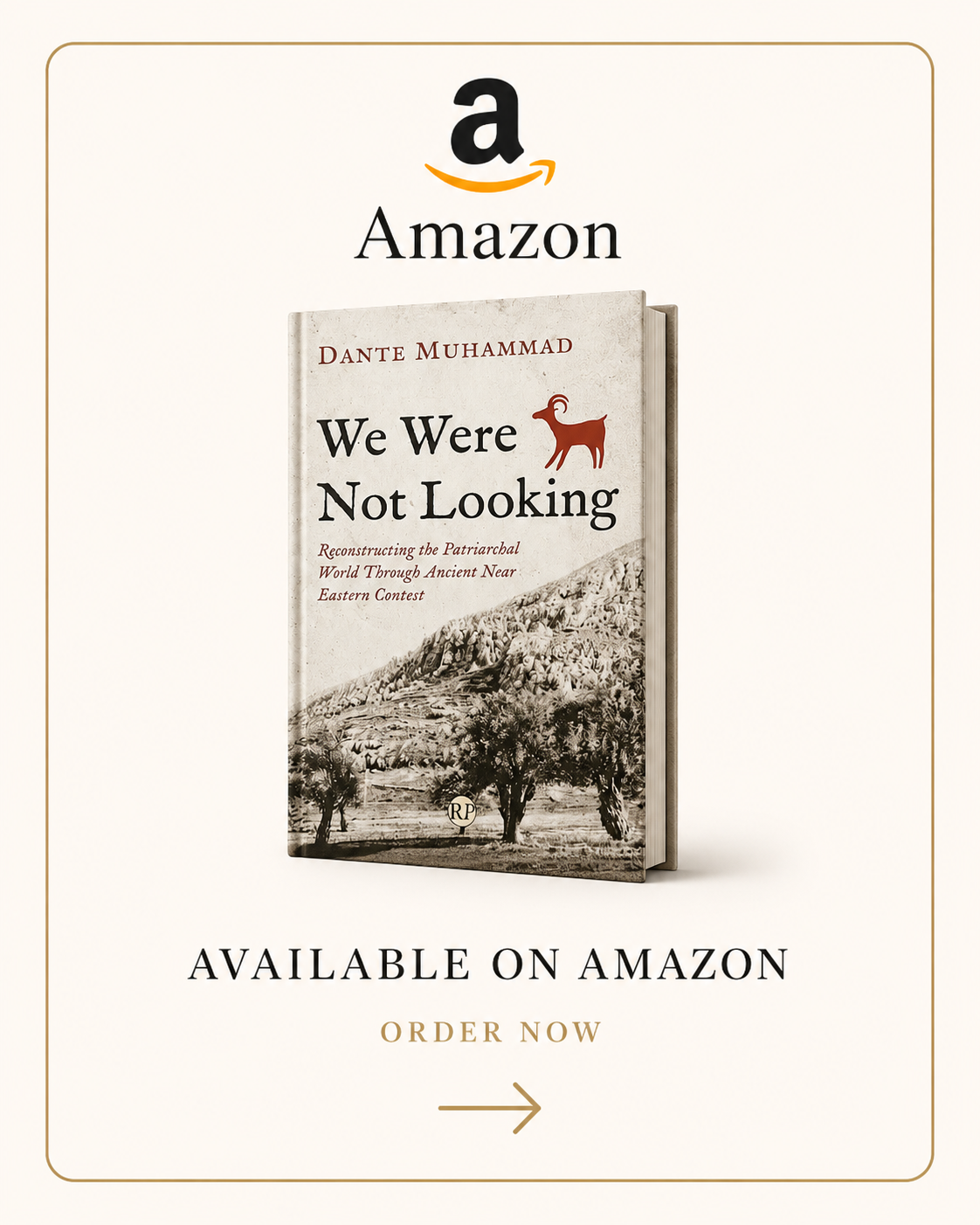
These questions also form part of We Were Not Looking: Reconstructing the Patriarchal World Through Ancient Near Eastern Context, published by Resource Publications, an imprint of Wipf & Stock.