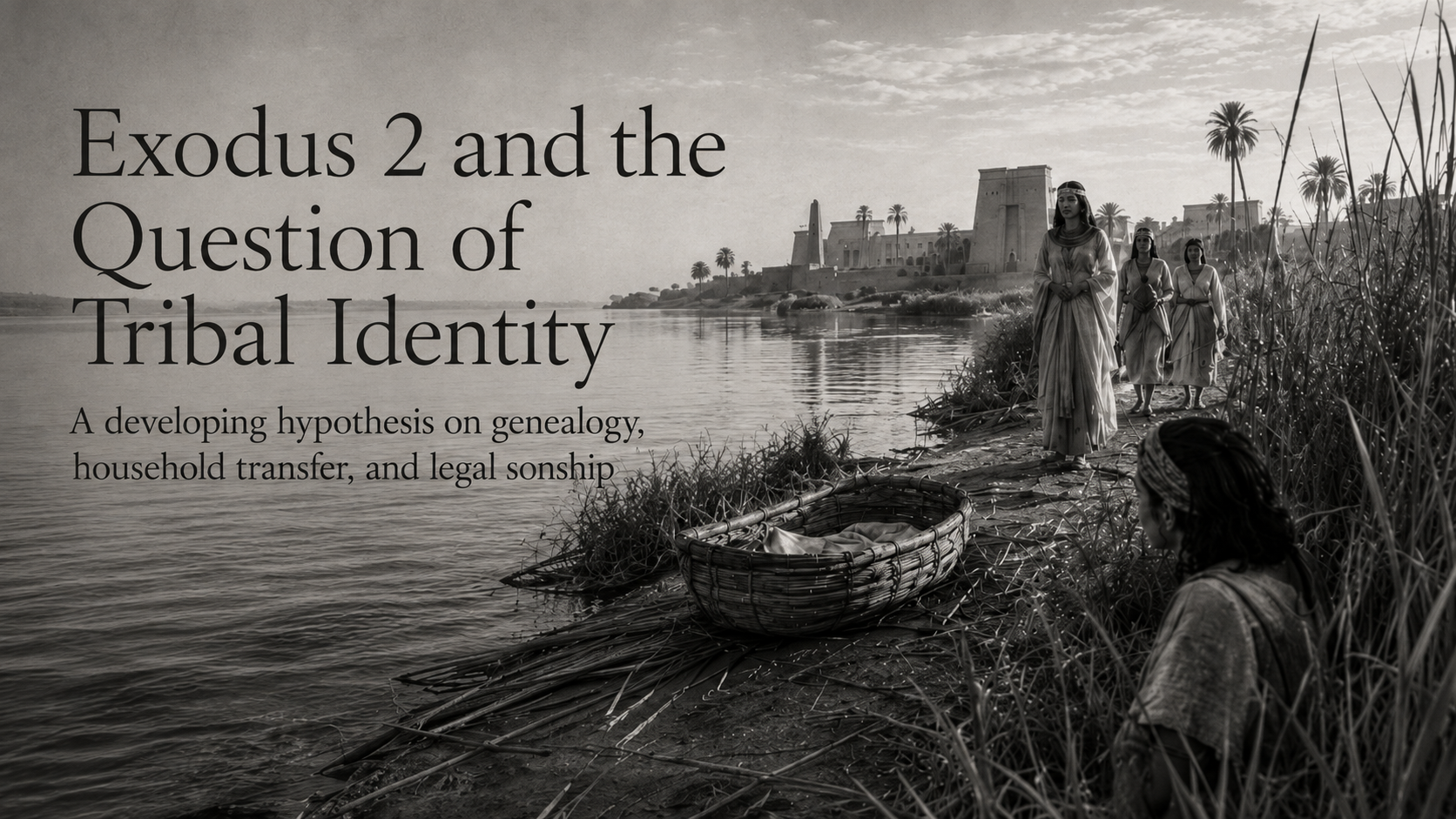
Distinguishing Tribal Identity from Narrative Memory in Exodus 2
The infancy story of Moses in Exodus 2 is usually read as a tale of desperation: a mother forced by decree to abandon her child, a basket set adrift, and a miraculous rescue by Pharaoh’s daughter. But the choreography of the narrative suggests something far more deliberate — a managed household transfer rather than accidental salvation.
This essay explores how the text may preserve two layers of identity: one official, one historical.
1. The Levite Identity: Official Belonging, Not Biological Reportage
Exodus 2:1 introduces “a man from the house of Levi” who takes “a daughter of Levi.” On the surface, this seems to settle Moses’ parentage. But biblical genealogies often function as identity assignments, not clinical biological reports. They establish:
belonging
legitimacy
inheritance
priestly placement
In other words, genealogy tells us how Moses is officially claimed, not necessarily how he was biologically conceived.
The Levite frame may therefore anchor Moses in a tribal identity that reflects theological and communal belonging rather than biological reportage.
2. The River Scene: A Choreographed Transfer, Not Abandonment
The narrative choreography of Exodus 2:2–10 is too structured to be accidental:
concealment
controlled placement
a watcher stationed at a distance
palace‑domain discovery
immediate wet‑nurse proposal
wage payment
the mother’s authorized return
eventual legal sonship
This is not how abandonment works. This is how managed transfer works.
The text preserves the memory of a household event in which:
the child is protected
the discovery is staged
the biological mother remains involved
the palace woman gains plausible deniability
the child’s status is converted into royal sonship
The wet‑nurse wages are especially telling. Wage payment transforms the biological mother into an authorized caregiver, allowing her continued presence without violating palace protocol.
3. The Watcher (ahôtô): The Operational Intermediary
Exodus 2:4 describes a female watcher — ahôtô — traditionally understood as Moses’ sister. But her actions exceed passive sibling observation. She:
monitors the outcome
approaches Pharaoh’s daughter
proposes the wet‑nurse arrangement
retrieves the mother
She is the operational hinge of the transfer.
If ahôtô is read more broadly as female kin — possibly the sister of the Levite man introduced in Exodus 2:1 — then she may function as a paternal aunt, a socially coherent intermediary capable of negotiating between households.
This reading is not required, but it fits the social mechanism implied by the narrative.
4. Legal Sonship: Moses Becomes Pharaoh’s Daughter’s Child
The text explicitly states that Moses becomes her son. This is legal parentage, not biological.
If Moses can become Pharaoh’s daughter’s son through household transfer, then his Levite identity may also function as legal or tribal assignment, not strict biological descent.
This does not prove Egyptian paternity. It simply opens the question:
What kind of fatherhood does Exodus 2:1 establish?
Ancient Near Eastern kinship allowed:
biological fatherhood
legal fatherhood
adoptive fatherhood
tribal fatherhood
household fatherhood
Identity was layered, not singular.
5. A Politically Sensitive Birth?
The narrative’s choreography — concealment, staged discovery, mediated negotiation, paid nursing, and palace sonship — fits the pattern of a birth requiring discretion.
Your development note raises the historical possibility — not as a conclusion, but as a research question — that the narrative may preserve traces of a politically sensitive birth involving:
an Egyptian man of status
an Amu/Semitic woman
a concealed union
a managed transfer
a later Levite anchoring
This is not asserted as fact. It is proposed as a testable hypothesis.
6. Layered Identity: What Exodus 2 May Be Preserving
Moses’ identity may be layered across multiple households:
official tribal identity (Levite)
event memory (staged transfer)
legal sonship (palace adoption)
concealed political reality (hypothetical but plausible)
The text is not “wrong.” It is multi‑layered.
7. Why This Matters
This reading reframes Moses’ infancy narrative as:
a story of managed identity
a negotiation between households
a legal fiction enabling maternal presence
a politically sensitive transfer
a layered account of belonging
It also opens new questions for further research:
How does ancient kinship shape identity?
How do genealogies function in tribal assignment?
How do narrative memories preserve social realities?
How do legal fictions operate in household transitions?
Conclusion
The infancy story of Moses is not merely a rescue narrative. It may be a story of managed identity across multiple households, preserving both official tribal belonging and older memory of a sensitive social event.
This layered reading does not weaken the text. It reveals its depth.